
Sustainability
Environmental friendliness, corporate social responsibility, and good corporate governance are factored into everything that we do and taken into account at every phase of the Laakso Joint Hospital project from design and engineering to construction and building maintenance. We have clear targets for sustainability and will measure our progress throughout the project.
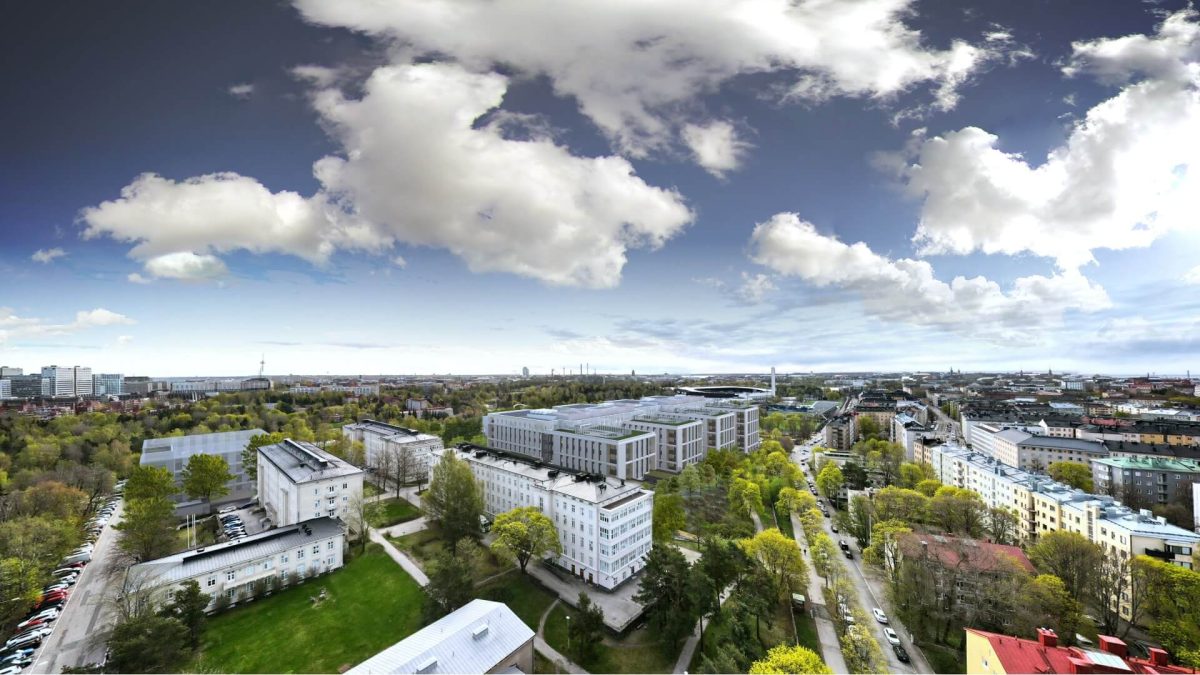
This page focuses on the environmental responsibility element of the Laakso Joint Hospital project.
The City of Helsinki and HUS have set ambitious lifecycle targets for the new hospital area, which are reflected in our approach to design and engineering. Both the construction works and the finished buildings must be
- energy efficient
- lifecycle sustainable
- observant of natural values
- resource-wise in all construction aspects.
Energy efficiency and renewable energy
A high degree of energy efficiency and extensive use of renewable sources of energy help to significantly lower the carbon footprint and energy consumption of the finished buildings.
The Laakso Joint Hospital project involves constructing three new buildings. They are being designed and built so as to make their energy performance at least 10% higher than the national minimum standard. The project also involves renovating two existing buildings and improving their energy performance in the process.
There are both waste-to-energy opportunities and renewable sources of energy available on site. Geothermal wells will be dug into the ground and solar panels installed on the roofs of the new buildings.
Carbon footprint and lifecycle cost
An estimate of the lifecycle carbon footprint of each of the buildings was calculated at the project planning phase. Embodied carbon emissions are being controlled by favoring recycled or otherwise low-carbon materials.
The project’s lifecycle cost is one of the criteria for decision-making.
Circular economy
Several buildings have had to be demolished to make way for the new hospital. The demolition crews were under strict instructions to sort their waste: All recyclable waste was taken to a facility that turns demolition waste into new construction products. Some of the concrete waste from demolition works and some of the rock extracted to enable underground construction will be used to landscape the grounds of the new hospital.
All other types of waste generated in the course of the construction works will also be sorted on site and recycled as comprehensively as possible. Any leftover materials will be used elsewhere. There are only a few types of waste that can be incinerated for energy production or taken to landfill.
The new hospital will have a highly sophisticated waste sorting set-up. The plan is to organize waste management in a way that enables efficient sorting at source and waste collection via a resource recovery center.
Sustainable mobility
The hospital area has excellent public transportation links and good access for pedestrians and cyclists. Once completed, the new hospital will have bicycle parking facilities and amenities for commuting cyclists as well as a number of electric car charging points (5% of all parking spaces).
Soundproofing
The hospital’s location in a busy part of the city has made it grow increasingly noisy over time, and improving the soundproofing of the existing buildings is an important aspect of the renovation works. The goal is to shield patients and staff from noise emanating from the outside, such as traffic noise.
Environmental impacts
The natural values of the area under development were carefully investigated during the construction planning phase. The surveyors identified, for example, a number of trees that must be preserved.
The Alliance is committed to observing the Green Deal for zero-emission construction sites, which initially sets limits on emissions from construction vehicles but will ultimately ban fossil fuels altogether.
Green roofs
The new buildings will have green roofs that will help to control stormwater runoff and to cool the microclimate and mitigate the urban heat island effect. In addition to being useful and attractive to look at from the outside, the green roofs will have decked areas for patients to enjoy.